Saint Mary-of-the-Woods College (SMWC) held its annual Theresa L. Gioannini Student Symposium & Poster Show.
Family, friends and members of the College gathered in the lobby of Le Fer Hall as more than 30 students presented their research and work completed over the course of the academic year. Their research and findings spanned multiple areas of study, including nursing, science and mathematics and social and behavioral sciences.
“Thank you for taking on this research challenge,” said Janet Clark, Ph.D., provost and vice president of academic affairs. “This symposium is our time to celebrate your academic success.”
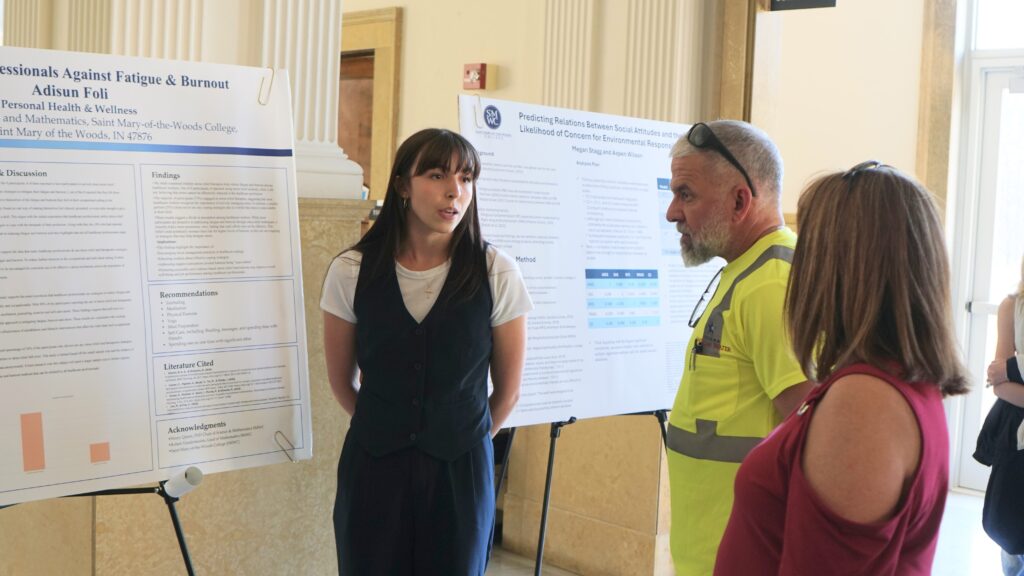
Symposium participant and alumna Megan Stagg ’25 was interested in understanding the relationship between religious beliefs and sustainability attitudes and behaviors. Stagg and her research partner, Aspen Wilson, used existing literature and included religious fundamentalism and right-wing authoritarianism as predictor variables.
“We also thought these variables would be interesting to include, given SMWC’s religious and spiritual history, so we included some items in the survey that can act as potential justifications for not behaving in sustainable ways, as well,” said Stagg, of Brazil, Ind., who earned her degree in psychology. “I think that we could say that we’re still in a phase of preliminary analysis, but it is showing significant results, and I think it will be really interesting to continue with this project. One thing I have learned is that when you ask a question like this, the answer is going to be incredibly complex.”
Wilson, a sophomore psychology and human resources major from Baytown, Texas, handled the project’s data collection and preparation.
“One of the main things I learned was how important data cleaning and preparation are in the research process,” she said. “Before this, I didn’t really understand how much work goes into making sure the dataset is usable, or even how it was conducted in a real-life setting. It was all a bit movie-like in my head, so learning how to conduct research was a lot of fun.”
The event is in memory of Theresa L. Gioannini ’71, Ph.D., who earned her degree in chemistry from SMWC and made several contributions to science.
The students and projects involved in this year’s event included:
Nursing
- De-escalation training in reducing workplace violence against psychiatric nurses – Alondra Castaneda, Ruby Gray and Matilda Hillsman
- Best practice for human Papillomavirus: Prevention in college-aged students – Michaela Cohee, Maya Murphy and Macy Schaffer
- CLABSI prevention in neonates – Lyndsay Crumrin, Hanna Boardman and Grace Geisler
- Sensory therapy and autism in adolescents: A literature review – Brooklyn Deck, Bishop Mellinger and Mikaela Wingler
- Effects of electroconvulsive therapy on patients with depression – Claire Donald, Samantha Dyche and Alexandria Sparks
- The effects of post-intensive care syndrome in an ICU – Charles Harr, Shirley Kennedy and Gabriel Goff
- Music therapy’s effect on agitation and depression in dementia patients – Allie Shaughnessy, Bentley Meyer and Carlington Henry
Science and Mathematics
- Stress level difference with athletes in team sports versus individual sports – Samara Douglas, Alexia Nowicki and Timi Olorode
- Managing stress and burnout among health-care professionals – Adisun Foli
- Community-based youth sports participation and mental well-being in young adulthood – Griffin Olson, Region Hendricks and Jaeden King
- Small towns, big stigma: Mental health perceptions in rural communities –ShayLynne Singer, Sebastian Reid and Mario Martinez
- Preliminary Exploration into the Use of Rosemary and Peppermint on Equine Stress Response *This project was completed in collaboration with the Department of Equine Studies – SaraGrace Toney and Savanna Amschl
- Effect of temperature on the growth stages of S. lycopersicum at The White Violet Center for Eco-Justice – Clara Westcott and Savanna Amschl
- Dining hall: How it affects our athletes – EmmaLe Zimmerman and Lanna Martinez
Social and Behavioral Sciences
- Predicting relations between social attitudes and the likelihood of concern for environmental responsibility – Megan Stagg and Aspen Wilson