
Saint Mary-of-the-Woods College’s (SMWC) ShayLynne Singer, of Terre Haute, unexpectedly found herself at the forefront of artificial intelligence (AI) research and can now call herself an award winner.
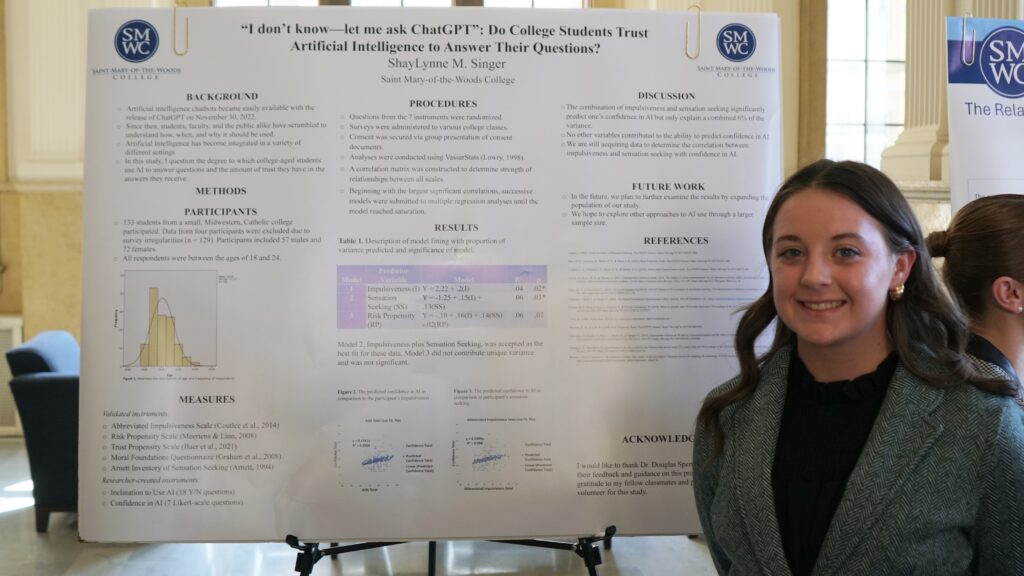
A junior double-majoring in psychology and kinesiology, Singer’s poster, entitled: “‘I don’t know–let me ask ChatGPT’: Do College Students Trust Artificial Intelligence to Answer Their Questions?”, was named the undergraduate winner at this fall’s Indiana Academy of the Social Sciences (IASS) Poster Show in Hanover, Ind.
“This topic developed after I gave a presentation in Dr. (Doug) Sperry’s Developmental Psychology class my freshman year, regarding sexual risk-taking,” she said. “I asked Snapchat AI a series of hypothetical questions related to sexual risk-taking to better understand if the media we consume is conveying the right message to vulnerable teens.”
Intrigued by Singer’s interpretation, Sperry encouraged her to expand her research.
“I first had Shaylynne in my class in the spring of 2024, and AI was a very current topic at that time,” Sperry said. “All faculty are sorting out how to use AI as a tool for good, not bad. I knew other people were interested in this topic, too.”
Last spring, Singer debuted her work at SMWC’s annual Theresa L. Gioannini Student Symposium and Poster Show, but it didn’t end there. Sperry suggested she take her research a step further and present it at the IASS Poster Show in the fall, where she became the College’s first-ever undergraduate poster winner at this year’s conference.
“This show was the only thing going on at that time of the conference, so it was a highlight of the day, not an afterthought,” said Sperry, who took three undergraduates and one graduate student to this fall’s conference. “When taking undergraduates to a conference, they often feel overwhelmed, but I’m a member of the Academy and my faculty colleagues in that forum are supportive of undergraduates.”
Singer began her research more than a year ago. With Sperry’s guidance in the Psychology 493 Research Practicum course, Singer looked at previous studies on whether college students trust advice from artificial intelligence.
After comparing different scales and questionnaires, she compiled a list of questions about individuals’ confidence in and willingness to use AI and presented the survey to several classes on campus.
Singer discovered that the more impulsive and sensation-seeking someone is, the more likely they are to trust AI. In contrast, individuals who scored low on risk propensity and did not typically participate in risky behavior could also have confidence in AI. Overall, her research showed that most college students have the potential to trust AI to some degree.
“This project exposed me to research methods and techniques that could further help to prepare me for a master’s program,” Singer said. “Research experience is typically something that most colleges want you to have when applying for these programs.”
Singer is now part of the 25 percent of psychology majors at SMWC who conduct research as an undergraduate.
“We certainly need professionals, but researchers and scholars are important for looking at how new evaluations and protocols work,” Sperry said. “I like taking my undergraduate students to this conference because it helps them to professionalize and discuss psychological facts in a way that is scientific that people in the field can talk about. This gives them a glimpse of what real-world psychology is all about.”